How to Order My Books

How to Order My Books

  Poetry by Julie S. Paschold Human Nature, Horizons, You Have Always Been Here  available now!!! Horizons & Human Nature AVAILABLE IN P...

Saturday, July 31, 2021

Funny Looking Critters in Your Field


A repost of a fun blog.....

WHAT IS THAT???!!?!?!

That thought has crossed my mind as I scout crops, when I accompany my son fishing, and as I walk outside along my favorite trail.  I have received that question from producers after I’ve been in their fields.  (And, frankly, insects have always fascinated me.  I wanted to be an entomologist in grade school when all the other girls were dreaming of being fashion designers! ha!)

There are some very interesting looking critters out there!

I will focus on insects in soybeans because that is where I’ve been spending the most of my time when I’m outdoors lately.  Most of the time, these guys do munch on leaves, but they aren’t at a distribution and concentration intense enough to cause worry or warrant treatment; they are either an annoyance to tolerate or novelty to be curious about.  Once in a while—like in 2018 with the thistle caterpillar—an unknown phenomenon creates an unusual proliferation of a certain species, and treatment is needed before the critter eats your livelihood. 

Without further ado, let me introduce to you some peculiar looking creatures.

Green Cloverworm


This insect is almost neon green and has two white “racing” stripes down its sides.  The green cloverworm is the larvae for a bland brownish moth.  When you touch or bother it, the larvae wiggles around.  The soybean looper looks similar, but has one less set of legs in the middle of its body, and it walks in a “loop” like an inchworm. 

Japanese Beetle


This insect is a beetle with a copper colored body and shiny green head.  Its antennae are feathered, and it has six white tufts on each side of its abdomen.  When it feeds on leaves, it doesn’t eat the veins, creating a skeletonized or lacy look.  It also likes corn silks.  They tend to hang out together, so you can find these guys in groups, climbing all over each other.  Japanese beetle larvae are white, c-shaped grubs with orange-brown heads. 

Silver Spotted Skipper


This insect is the larvae to a brown butterfly with a silverish-white spot on its wings, hence the “silver spotted” in its name.  It has a distinctive looking larvae that turns many heads, with the light green body, dark brown head, and orange “cheeks” or “eyes” that make it easy to identify. 

Thistle Caterpillar


This insect is the larvae to the painted lady butterfly, whose wings are a decorative orange, brown, and white.  This year, I’ve heard lots of comments about people seeing these butterflies in swarms, and picking them out of the grilles of cars in great numbers.  The small larvae are darker, almost black, with small “thistles” or spikes on them.  As they grow, they use webbing to wrap themselves in the leaves that they eat, creating a safe “home”.  Here, their fuzzy brownish black heads work quickly to eat the leaves, leaving lots of big black frass (a cool name for poop....or a rock band.....) as they grow into more colorful, spikier caterpillars. 

Gorgone Checkerspot


Okay, I’m not completely sure about this one—I found it south of Wahoo, Nebraska on a sunflower leaf.  But the closest I could find was the larvae to a gorgone checkerspot butterfly, who does like sunflowers and is found in our area.  He was kind of cute and was posing so beautifully that I just had to take his photo. 

Soybean Gall Midge


This one is so tiny there is not a great chance you’d actually see these guys in the field.  But their damage is so terrible they kill the entire plant when the larvae burrow into the base of the stem.  They’re cool because they are a newly discovered species, and I just confirmed them in one of my fields.  So, yeah, this is my photo, and these guys are only known to us for a couple of years now.  They are the orange maggots to a striped midge fly that’s equally as tiny as its larvae. 

Thanks for reading!

Photos all courtesy of Julie S. Paschold.  May not be used or copied without permission of author.

July 24, 2019

Julie S. Paschold

Wednesday, June 9, 2021

Why I Don't Suicide


Facing the truth isn’t always easy.

The truth about my mental illness is that with it come thoughts of suicide.  I didn’t choose my illness, and I didn’t choose my brain.  What I can choose is what I do about those thoughts.


Sometimes I don’t do it

because who would take my cat?

Sometimes I don’t do it

because my kids are too young

to sort out my stuff just yet.

Sometimes I don’t do it

because I don’t have the energy.

Sometimes I don’t do it

because I don’t have the brain power

to come up with a plan.

Sometimes I don’t do it

because I couldn’t afford the hospital bills

if I failed.

Sometimes I don’t do it

because I don’t want to have to

explain it to everyone.

Sometimes I don’t do it

because I don’t want to pass my debt

on to others.

Sometimes I don’t do it

because I don’t want others

to have to see the pain I truly am in.

Sometimes I don’t do it

because I can’t

explain it to anyone.

Sometimes I don’t do it

because I can’t afford the therapy.

Sometimes I don’t do it

because I tell myself

I can handle it for just one more day.

Sometimes I don’t do it

because I can convince myself

the voices are monsters in my head

telling me the wrong things.

Sometimes I don’t do it

because my cat comes up to me

and nudges me in a way

that I know he is saying he loves me.

Sometimes I don’t do it

because someone calls or texts

just to say hi.

Sometimes I don’t do it

because the piano music I’m playing

speaks to me in a way that says

just hold on.

Sometimes I don’t do it

because a high school classmate

posts a message describing

their own struggles

and I know I’m not the only one.

Sometimes I don’t do it

because I find a message

my son left a long time ago

on a notebook for me.

Sometimes I don’t do it

because I know my daughter

saved my life once upon a time.

Sometimes I don’t do it

because I can journal my way

through it.


6-7-21

Tansy Julie Soaring Eagle Paschold

Saturday, May 8, 2021

Imposters

This was originally written in June 2019, when a certain soybean pest was first discovered.  I am reposting this blog here.


Have you ever seen something that was actually something else?  Or, rather, have you ever thought you saw something, but it actually was something else?  Not necessarily as extreme as the whole Baby-Ruth-in-the-swimming-pool drama (what movie was that anyway?), but in life, we seem to come upon things, or people, or events, or places that seem to be what they’re not.  Early in my science classes, I learned about the “false advertisers” of the caterpillars that have spots to pretend to be snakes, the viceroy butterflies who mimic the markings of the poisonous monarch butterflies, or the stick insects that look like twigs and leaves that even look like they sway in the wind! 

I have learned that not everything is what it seems.  That is why, in agronomy and in the field, I have to look twice to identify those imposters. 


Probably the most common example of mistaken identity in corn is misidentification of purple leaf sheath as physoderma brown spot.  Later in the growing season, as the stalk widens, the leaf sheath tends to collect particles.  When moisture and heat react with these leftover dust, pollen, and “trash” particles, they discolor the leaf sheath, leaving a benign purplish, blackish spot on the top where the leaf is connected.  Often, this is misidentified as physoderma brown spot, a fungus which can develop into a stalk rot.  Purple leaf sheath isn’t a disease—it’s just a funny looking spot similar to a mole on your arm. 


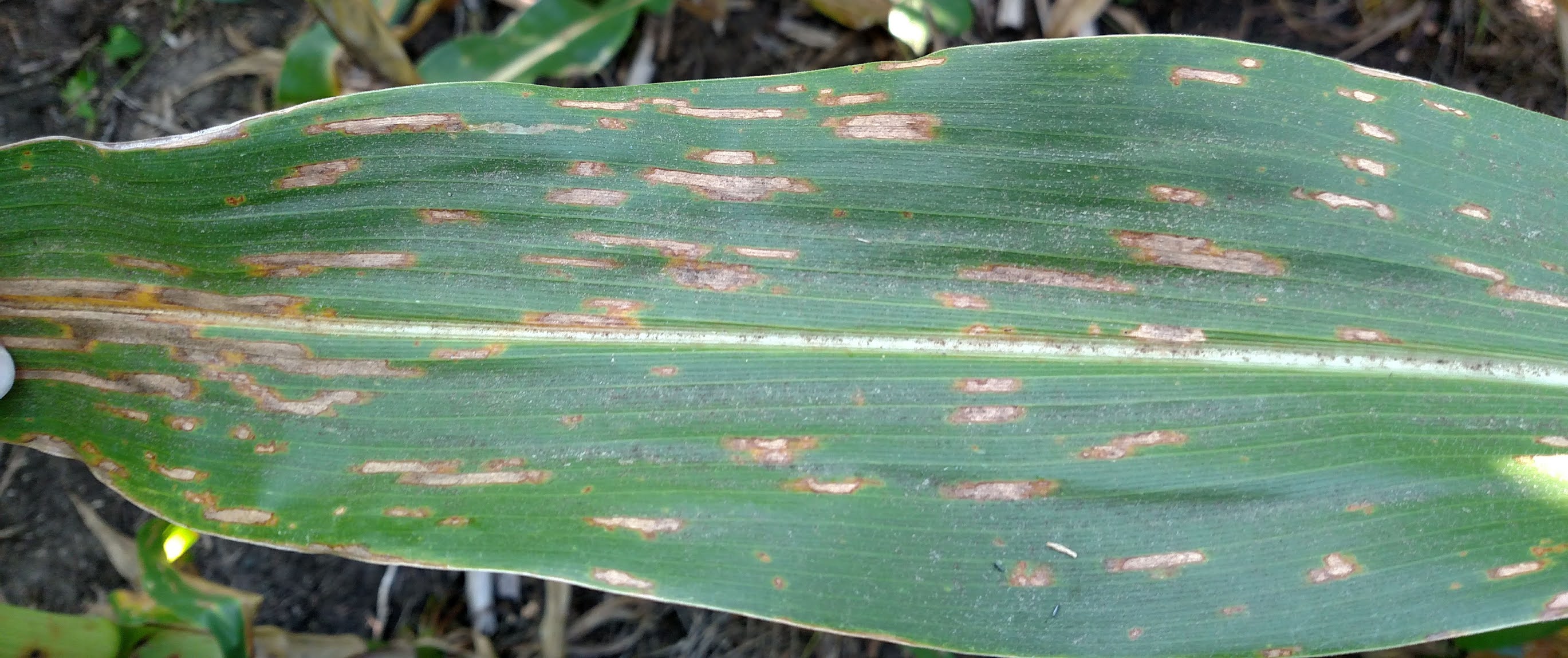
Sometimes, when a new disease is found in the area, people begin to “see” it everywhere.  Recently, bacterial leaf streak was identified in corn.  This is a bacteria that causes wavy leaf lesions that are yellow in color when backlit.  It can look like other diseases that cause leaf lesions, especially grey leaf spot.  Unfortunately, grey leaf spot is a fungus and controlled by fungicides, which will not control bacterial leaf streak.  Sometimes corn leaf blotch miner feeding can look like bacterial leaf streak because they feed on the juicy inside of the leaf and leave the outside film.  Other times, sun scald or wind damage can look like leaf lesions from a disease. 

Another disease that’s new to our area is tar spot.  This is one that looks similar to our common or southern rust, but there are slight differences.  A rust is called that because it “rubs off” when you scrape at the lesions.  Tar spot does not.  The spots are usually dark in color, and not the rusty color that common and southern rust start out at, either. 


And, last, but certainly not least, was the one that baffled me last year.  I was near Pender in a soybean field.  This grower had quite a bit of flooding earlier in the year, and had lost some of his field from that damage.  The growing season turned into a hot one.  This brought quite a bit of disease to the corn, which didn’t surprise me.  I expected some disease to show up in his soybeans as well.  That is why, when the edges of two of his other fields which were close together showed symptoms of what seemed to be phytopthora, it didn’t alarm me.  The patches of droopy, dying plants were just one more thing for this poor guy to have to treat.  However, when I went to check on the soil and root system, the roots weren’t brown and rotting like the rest of the plant!  This isn’t classic phytopthora at all!  My puzzlement was alleviated this winter at a conference when I discovered the clever little soybean gall midge, a new species discovered in the area affecting soybeans.  The larvae of this little striped fly burrows into the soybean stem, killing the plant and causing symptoms that look like phytophthora without the root rot.  Huh.  One more imposter to put on our list and remind us why we always need to keep our eyes peeled and our minds sharp! 

Monday, June 3, 2019

Julie S. Paschold

Saturday, March 13, 2021

Chemical Resistance Part Three: What To Do?


Chemical Resistance Part Three: WHAT TO DO?


In Chemical Resistance Part One we discussed how misusing chemicals can create “superbugs” by creating a chemical memory that critters pass to their next generation (what doesn’t kill you makes you stronger; nothing in science is 100%). 


In Chemical Resistance Part Two we discussed the three main ways chemicals are misused that create these superbugs: using only one chemical for treatment (a boxer using only a right handed uppercut), using the wrong chemical for the wrong critter (antibiotics used on a virus), and using the wrong dose (the chemical storm isn’t the appropriate strength). 


Again, I use the word “superbug” and “critter” to describe any pest that causes problems and requires treatment methods, be it bacteria, virus, fungus, insect, arthropod, or weed.  The words “chemical”, “medication”, “drug”, and “pesticide” are usually used interchangeably. 


But what can we do to prevent superbugs from taking over the world?


There are three general ways to treat and prevent critters developing resistance to chemicals used as pesticides:

a.       Use more than one specific chemical, making sure that the different types of chemicals affect the pest in a variety of ways.  In the world of pesticides, this is called using multiple “modes of action”.  If possible, use non-chemical means as well.  To use our “Rocky” boxer superbug example, this would be choosing a number of moves to defeat our opponent, utilizing uppercuts, jabs, crosses, hooks, ducks, and even shoeshines with both hands.  And move those feet! 

b.       Make sure you know what critter you’re fighting.  If visual details don’t tell you (in the form of symptoms or identification of the pest), call an expert (like a doctor or agronomist), and send in a sample to a lab to be identified.  {Nerdy note: Lab rats are cool and know so much!}

c.       Use the right dose.  Have a large arsenal that includes more than just treating symptoms with chemicals after the fact.  Consider all factors needed to make an informed decision.  Can you prevent future problems?  Take ALL the medication; read the labels!  Know how to use the chemical. 


In the agronomic world, there are three types of pests: Weeds, Diseases, and Insects


Weeds


a.       Herbicides have different methods of killing weeds.  Their modes of action include stopping the synthesis of amino acids (what makes up proteins) or lipids (what makes fats), stopping photosynthesis (how a plant makes its own sugar or food), and messing with growth regulators or cell membranes.  {Nerdy note: want to give a plant a permanent?  Give it a growth hormone disrupter like dicamba.  Plants do not like perms.}  Non-chemical methods of weed suppression include crop rotation, tillage, narrow row spacing, changing the crop’s planting date, and roguing unwanteds that escape other methods (c’mon, what teen living near a farm hasn’t walked beans?!?!?). 

b.      The best way to know what you’re up against in a field as far as weed pressure and type go is to actually go walk in the field—all of it.  Identify the weeds correctly.  Take photos or samples to someone if you don’t know for sure. 

c.       Don’t stop with knowing what kinds of weeds are out there, where they are, how big they are, and how many of them are out there, but know the history of the field as well.  What problems has this field had in the past?  What crops have been farmed in the past?  What are the tillage and irrigation practices?  What else has been used or tried?  Read the label for the herbicide: What mixes of chemicals are best for the weeds out there?  What adjuvants need to be used (or avoided) to make the chemical more effective?  Does the chemical need to be incorporated into the soil to intercept roots or coat the leaves of the weeds?  Does it need rain to activate, or need to dry a certain amount of time before there is precipitation?  Is it a residual, or does the chemical only work on contact?  If this overwhelms you, call an expert—find an agronomist!


Diseases


a.       Many crops have a number of hybrids or varieties that have been tested to be resistant to several diseases.  If you know a field has had trouble with a certain disease in the past, choose the right seed to prevent problems from occurring.  Modes of action for fungicides include stopping respiration {Nerdy note: fungi breathe, did you know that?}, rupture cell membranes, stop growth or mitosis (their method of reproduction), and messing with metabolism (how they use energy or get their food). 

b.       What exactly is the problem with the crop?  If it is a disease, make sure the symptoms only point to the one disease.  There are laboratories that test for this.  Many crop diseases are fungal, but there are bacterial and viral infections, too.  Is it a nutrient deficiency?  Perhaps the crop needs fertilizer.  Is it a root issue?  The soil could be water logged, or there could be a drought.  Is it from insect damage?  {Nerdy note: There is a new species of insect called the soybean gall midge that attacks soybeans whose symptoms mimic the disease phytophthera.  Tricky little critters.}

c.       When choosing a chemical, are you using seed treatment when planting or foliar spray once the symptoms are showing?  Does the chemical get placed in the soil or on the plant?  How long does it need to dry—check the weather.  How developed are the plants?  How severe is the disease?  Where is the disease located in the field—confined only in spots, along the edges, or in the whole field? 


Insects


{Nerdy note: This category includes arthropods and other creepy crawlies that are insect-like, too.  Mites, which are a pest, are actually cousins to spiders and not insects.}

a.       Some crops have traits that were bred to prevent specific insect damage.  Insecticides have modes of action that alters, inhibits, or interferes with how the pests breathe, grow and develop (like moulting or hormone development), metabolize food and energy, nerves, and muscles.  Many pests have natural enemies, and introducing or encouraging beneficial insects can help keep a low threshold number. 

b.      What exactly is the true case of the problem?  What is the pest?  Many larvae and beetles look alike or have variety within the same species.  Know what damage they cause and how they act.  Do they feed on the leaves or the roots?  Do they bore through the stems?  Do they hide in the grain or lay their eggs near the top or bottom of the plant?  What does their frass {Nerdy note: this is a fancy word for poop} look like?  Capture a critter, take a picture, pull apart and sample the plant—send these in if needed. 

c.       What is the developmental stage of the pest and the crop?  If it is a borer, are most of them in the plant already?  Is the crop almost into the next developmental stage—for example, is the corn almost done tasseling and silks turning brown?  Are the larvae changing into pupae or their adult stage (beetles or moths)?  It might not be useful or economical to spray a chemical if the pest or crop is changing or hiding already.  If using a chemical, read the label.  Like I discussed in the weed section, know the history of the field. 


Farming isn’t just sticking seed in the ground, waiting around, and then harvesting in the fall.  It involves noticing details, and knowing them, too.  You don’t have to know everything, though—that is what experts are for.  Get a hold of an agronomist or a lab rat. 


{Nerdy pun warning}

When you’re out standing in your field and see something that puzzles you, find someone that is outstanding in their field to help you have an outstanding field!!!!!


Thanks for reading!

Until next time,


Julie S. Paschold

5-9-2019